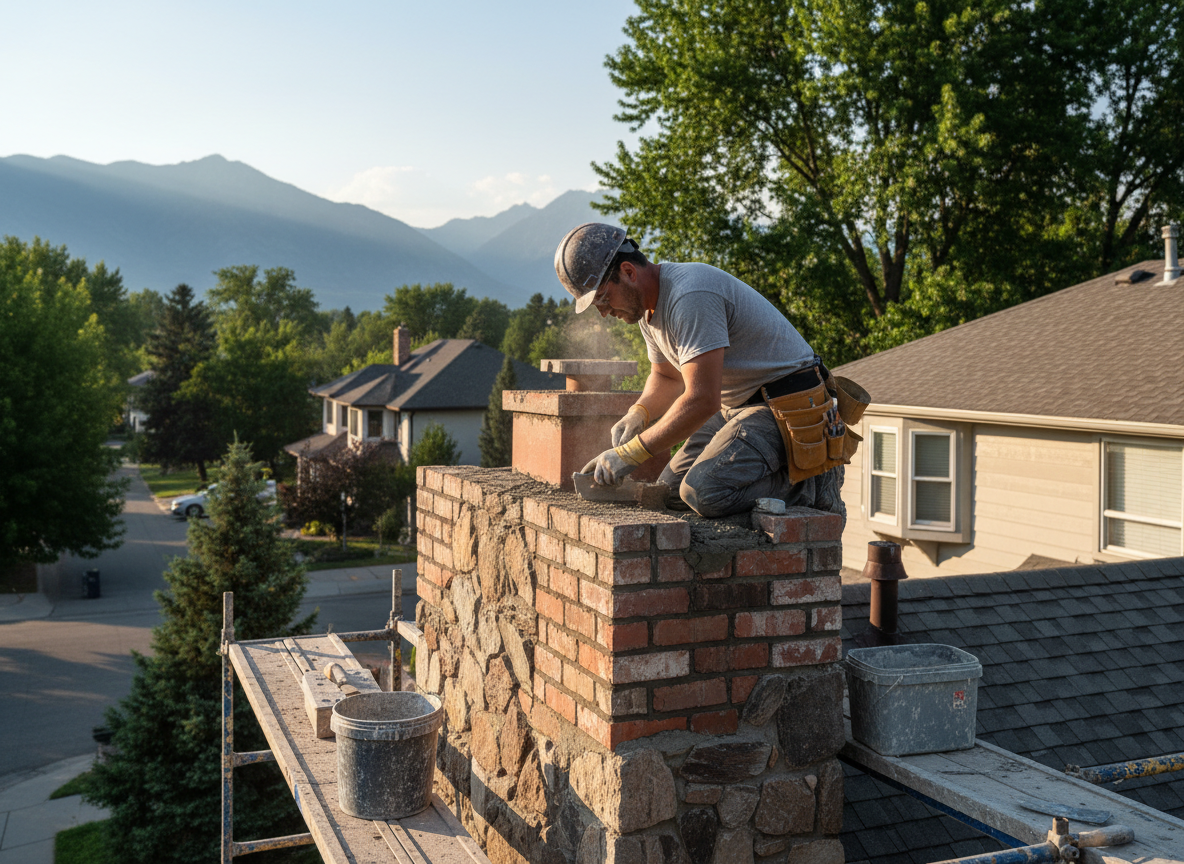
Holladay homes built in the 1950s through 1970s around Holladay Village and Olympus Hills Park often feature original brick chimneys whose mortar has eroded from repeated freeze-thaw cycles. Cold snowy winters followed by warm days create expansion and contraction that loosens joints, allowing water to penetrate and accelerate spalling on the south and west faces most exposed to sun and wind.
Tuckpointing here requires raking out old mortar to a consistent depth without damaging the soft brick common in Salt Lake County construction, then packing new mortar matched to the original color and hardness. Workers must account for the semi-arid climate that dries mortar too quickly in summer, so timing and misting techniques differ from jobs in Millcreek or Salt Lake City proper.
Chimneys near Cottonwood Heights or Mount Olympus sit on steeper slopes where runoff and wind-driven snow increase water intrusion at the roofline. Proper tuckpointing includes checking flashing integration and crown condition to prevent future leaks into attics common in these split-level and ranch-style houses.
Failing to address deteriorated joints before winter can lead to water tracking down flue liners and damaging ceilings, especially in the older stock found between Holladay City Park and Highland Drive.
Technician insight
In Holladay, the thing that catches most people out with chimney tuckpointing is how quickly water gets behind the brick on south-facing chimneys once the mortar starts failing; the freeze-thaw here is brutal because we get snow followed by bright sun that melts it right back into the joints, especially on the older homes along Highland Drive and in Mount Olympus.
Mount Olympus chimney joint failure
A homeowner in the Mount Olympus neighborhood noticed interior ceiling stains after heavy spring snowmelt. Inspection revealed eroded mortar on the south elevation allowing water past the crown. We raked and repointed the joints, matched the original mortar, and confirmed flashing integrity. Water intrusion stopped and the brick remained stable through the following winter.
How it works
- 1
Inspection and joint assessment
Technicians examine every elevation from the roofline down, noting eroded mortar, cracked crowns, and flashing gaps typical after decades of Salt Lake County freeze-thaw exposure.
- 2
Mortar removal
Old mortar is raked out to uniform depth using hand tools to avoid damaging the softer bricks found in Holladay homes built before modern additives.
- 3
Mortar matching and application
New mortar is mixed to match existing color and strength, then packed firmly into joints while monitoring drying rates influenced by the area's hot summer afternoons.
- 4
Finishing and weatherproofing check
Joints are tooled for proper profile, excess material removed, and roofline details inspected to ensure water sheds away from the structure before the next snow event.
Pricing
Cost depends on chimney height, number of elevations requiring work, and extent of mortar loss from winter damage.